Jan
10
2012
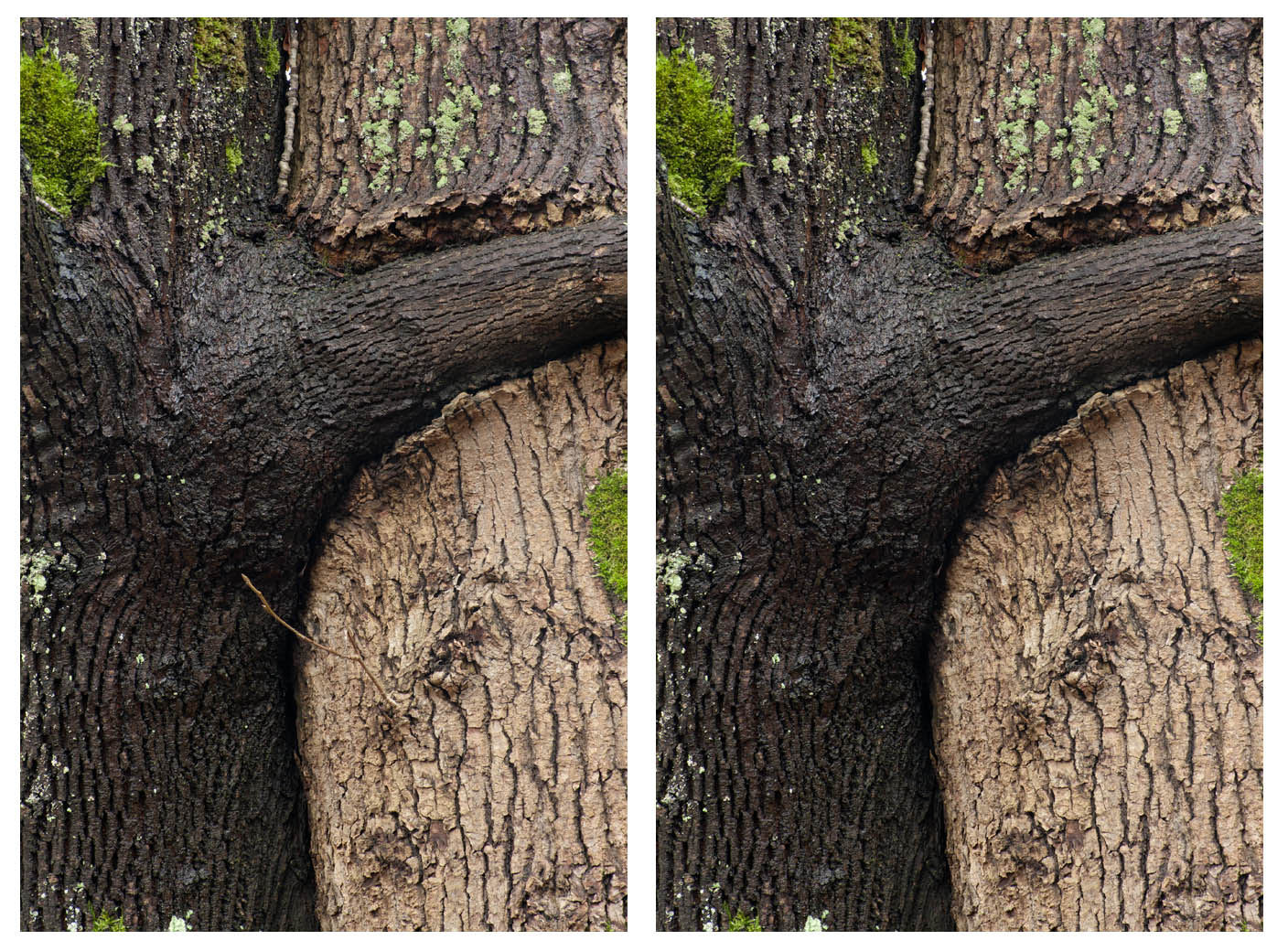
I wanted to show a simple example of how powerful a point of high contrast can be in a composition. Despite the small size of the light coloured branch it’s contrast against the darker tree pulls the eye to it. In this case it is not the intended center of interest and it therefore detracts from the image. While it is no longer strictly a photograph but also a manipulated image it is a better and simpler composition. So would we say the same thing if I had done the pruning then and there as opposed to digitally? That I will leave to you to decide.
no comments | tags: composition, Photography | posted in Composition, Photography
Jan
9
2012
All of these shots except the apple were done with the Pentax SMC A 28mm lens on the Pentax K10D. For the apple I used the SMC A 70-210 F4. The 28mm on my APSC cameras gives an equivalent field of view as a 42mm lens would on 35mm film, which lies somewhere between the 35mm of many film point and shoots and the 50mm “normal” prime that came with many film SLR’s. Once in lightroom I played around with the images trying to get a film like look based on other shots I took that day with the Pentax MV and 400 ISO film. Between using the older glass and the processing I think I created images that look like they could have come from a film point and shoot camera which was my intent. The preset can be downloaded by right clicking on the link and selecting save as. Wkoopmans Colour Film P&S template One of the problems with creating this preset is adding the grain. Lightroom added the ability to introduce grain to an image with Lightroom 3 but it is a simple solution that works best with black and white film. The grain of colour film is more complex with different amounts of colour mottling that Lightroom has no answer for.
3 comments | tags: Digital, film, Lightroom, Pentax, template | posted in Photography, Processing
Jan
5
2012
The B.C. sugar refinery warehouse building is very photogenic and I couldn’t pass it up when I was at the Vancouver waterfront recently. There is little point to me writing about it’s history as there is an excellent article in the Vancouver Sun that covers it all. Sugar Coated History
3 comments | tags: Digital, Nikon, p7000, Photography, Vancouver | posted in Photography
Jan
2
2012
No Mulberry bushes though, I don’t even know what they look like. But these were all shot one morning with my Nikon P7000 when I went for a walk, on a cold…
no comments | tags: Digital, frost, Nikon, p7000, Photography | posted in Photography
Dec
30
2011
While watching a documentary on Fred Herzog Snapshot: The art of Photography II, a Vancouver photographer best known for his Kodachrome slides of the city during the 1950’s and ’60s, I was struck by his use of the Canon WP-1 while being interviewed on the street. It got me to wonder why he would be using a 15 year old point and shoot camera. Never having met him I clearly have not asked why but here are my reasons that he might choose this camera despite all the other options available. These are not in any particular order but as they come to mind.
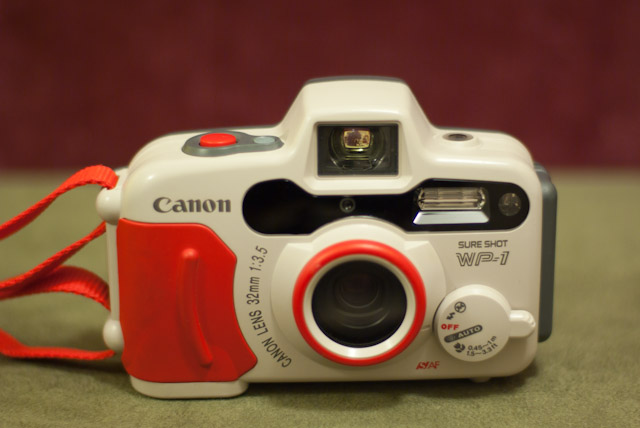
1. It is weather proof (this can be an important thing in Vancouver at some times of year)
2. It has an large viewfinder with a 33mm eye-point in fact you can compose pictures with out even bring it right to your eye.
3. It has a simple control dial on the front that does all the functions in a simple arrangement (Flash Off,Flash On, OFF, Auto, Macro) the only buttons are shutter and timer
4. It is quiet, the shutter and film advance are on the quiet side for a point and shoot film camera likely going unnoticed on the street.
5. The Lens is 32mm which is wide but not too wide
6. Here I may be stretching things but because of its construction the lens is completely internal allowing you to put the camera right up against glass.
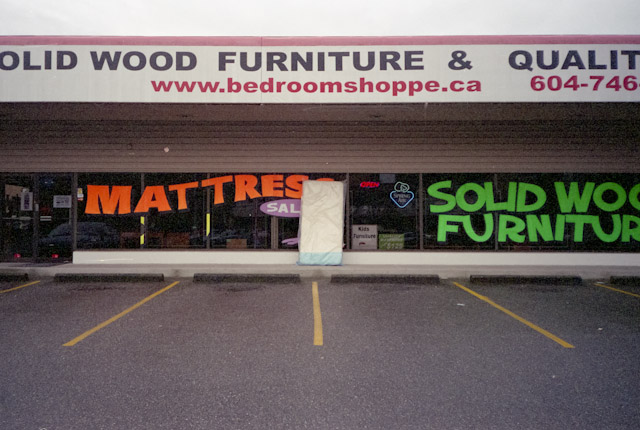
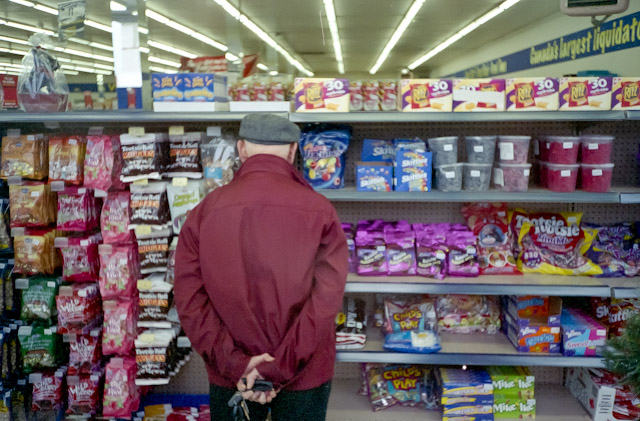
That seems like plenty of reasons to me. So with some new found interest in retrying this camera I loaded it with some film (I will refer back to this in a moment) and went out and shot a roll of 24. And the result is that despite it’s toy like and slightly ugly appearance it functions well as a wide angle street camera with little fuss. Now as to the film, unfortunately I shot what was film in name only. I need to find any other rolls of this stuff and do an analogue delete on it. I think I’m cured, for now, from my pentient for shooting with anything I find or am given.

2 comments | tags: Canon, film, WP-1 | posted in Cameras, Photography
Dec
28
2011
A walk a long the Trans Canada trail in Burnaby B.C. gave some interesting industrial views. I shot these all with the Nikon P7000 which is much improved in operation since the latest firmware update (Version 1.2). One of the problems addressed by this update was the focus system. It is the one area that really caused me issues particularly focus at the long end of the zoom. Previously it often failed to lock focus despite having a good contrasty subject and lots of light. Now the camera focuses without problem at all focal lengths. Also improved is it’s ability to focus in low light, and the overall speed of focus. It really can’t be over stated this is a major update that anyone with a P7000 should consider doing. The P7000 has become my default carry everywhere camera with it’s very effective 6.0 to 42.6mm (28-200 equivalent) zoom. The P7100 that replaced it uses the same lens and sensor so while it may have improved operation the final result will be the same, for this reason the P7000 is an excellent deal while they are still available and I would buy another one despite all the other cameras competing in this class.
5 comments | tags: Nikon, p7000, Photography, steel | posted in Composition, Photography
Dec
26
2011
Somehow a mundane sky can be lifted to a higher place just be shooting it in infrared.
1 comment | tags: infrared, Photography | posted in Photography, Processing
Dec
23
2011
This poor post has been sitting waiting for months, everytime it’s turn comes up I write something else, so in the spirit of the season. Here you go little post off into the world with you.
no comments | tags: Photography, signs | posted in Composition, Photography
Dec
21
2011

Something happened along the way to this blog post. I had originally intended to show the difference in output from these two cameras using their respective film formats (35mm for the Big Mini and APS for the Super Big Mini) but the thing is that it really is indisputable that 35mm film is better so I decided to just throw all of the shots together and forget about it. Several things are apparent however. The wide aspect of the APS film can be used to make an interesting difference in some compositions, it amounts to 16:9 when you use the entire frame and the other thing is that the Super Big Mini has quite a bit of vignetting with the larger 35mm film.

Big Mini and Super Big Mini (which is actually a double oxymoron)
6 comments | tags: 35mm, APS, film, Konica, mini | posted in Cameras, Photography
Dec
19
2011
Back in olden times, when surfing the Internet was preceded by the squelch of a phone modem and required you to know the URL of the sight you wanted to go to, film manufacturers decided to make things more convenient. Not for the Internet, they didn’t see that coming, but for handling film. What they came up with was APS film and what it addressed was the loading and storage of the film. The film stayed inside the cartridge completely until loaded by the camera and was stored inside the cartridge again after being developed. People using APS film never actually saw the film itself. In creating the cartridge though they did one other significant thing and that was reduce the film size as compared to 35mm film which was and is the film size that most people are familiar with. The side effect of this reduced size is also a lowering of picture quality, especially evident when the images are enlarged beyond a certain size. Because most of these pictures where never printed larger than 5″x7″ this largely goes unnoticed.
Fast forward several years and we are now searching the Internet more effectively but not yet Googling. At this point digital photography’s is skyrocketing and film use is plummeting. APS film being the weaker of the film formats with a much smaller user base was the first to be left behind. A lot is happening within digital photography at this time, point and shoot cameras actually suck and produce inferior images and cost large sums of money. Digital SLR’s are only just becoming available and also cost large sums of money. Most DSLR’s then as now came out with either a sensor the same size as 35mm film often referred to as “full frame” or the smaller APS-c or “cropped sensor”. Why would manufacturers even bother with producing sensors the same size as the failed APS film you might ask. The reasons are mostly down to the cost of manufacturing the sensors and as it turns out the full frame ones are a lot more costly relative to there size. So in order to create a market for DSLR’s camera makers needed to bring the costs down to a point that enough people could afford them, how else could they sell lenses. I remember it was a big deal when the first sub $1000 DSLR was released in around 2006.
From day one it was clear that full frame sensors were better than APS-c ones as it had been between the two film sizes. Manufactures helped to make this clear also by putting full frame sensors in their big rugged professional cameras and APS-c sensors in their consumer offerings. And that is how it’s been for about ten years, but the thing is that sensors have been steadily improving with each new iteration and the gap in image quality between full frame and APS-c has narrowed. This may be as much a result of companies putting resources to where they feel they will get the best return. After all they are not out to produce the best camera with no concern for cost they are competing hard to stay ahead of each other in the market place. There are many more things going on in digital photography including other sensor sizes and camera forms but within the DSLR world it’s mostly about full frame and crop sensors.
So if full frame sensors result in better image quality in general then what if any advantage other than cost do crop sensors provide? Well because of there smaller size they record a narrower field of view from the same focal length lens. This is often referred to as the crop factor. This “crop factor” is roughly 1.5 times for most APS-c sensors. The result is that for example a 100mm lens on APS-c provides the same field of view as a 150mm lens on full frame. This relationship is true for any focal length so that a 300mm lens becomes equivalent to a 450mm lens on full frame. In this case it’s clearly an advantage for people wanting a long telephoto lens. The opposite is true for wide angle where what was a wide 18mm becomes equivalent to a 28mm lens on a full frame camera.
So why did I title this post revenge of APS? Well it’s been a long road but we are at a point where some of the most recent APS-c sensors can perform at the same level as full frame sensors. This may not be a universally held belief but it’s pretty easy to argue that the difference isn’t nearly what it once was. It’s true that “full frame” cameras provide a shallower depth of field, but may not be the be all end all of photography. I find myself again on the side of the argument that ends with the question. If the viewer of an image has no idea how it was made does it matter how it was made?
In a future post I will time travel back to 1996 and compare two otherwise similar cameras having the key difference that one took 35mm film and the other APS.
5 comments | tags: APS, Cameras, film, Full Frame | posted in Cameras, Photography, Uncategorized


