Mar
21
2013

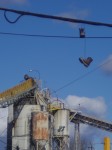
I chose this lens from my parts bin because it was a complete package including a helical focus system, unfortunately I don’t know what camera it came off but it appears to be a 40mm f2.8. That 40mm when converted to a full frame equivelent is 220mm. Once I figured out the distance it needed to be placed from the sensor I mounted it on the end of a piece of ABS tubing which also attached to a modified Q to C-mount adapter I had purchased on the internet. Initial testing was done with no aperture, it was wide open. The resulting images were soft and lacked contrast as you can see with these following images.
My next step was to line the inside of the lens with black velvet paper to keep down the internal reflections and create a fixed aperture to try to improve the lens performance. These changes had a dramatic impact on image quality.
But I wasn’t quite done. I made a new aperture that was a bit smaller and did some more testing. This is the state that it is at right now.
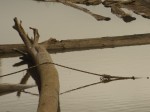
I was likely 100 feet away from the rebar in the one picture and you can see that the bridge, hundreds more feet away, was also in focus. That isn’t always a desirable quality especially if you want to use selective focus to separate different planes in an image but on the other hand this is a feat you can’t easily accomplish with a large sensor camera if it is what you want. And the lens is very small I might add.

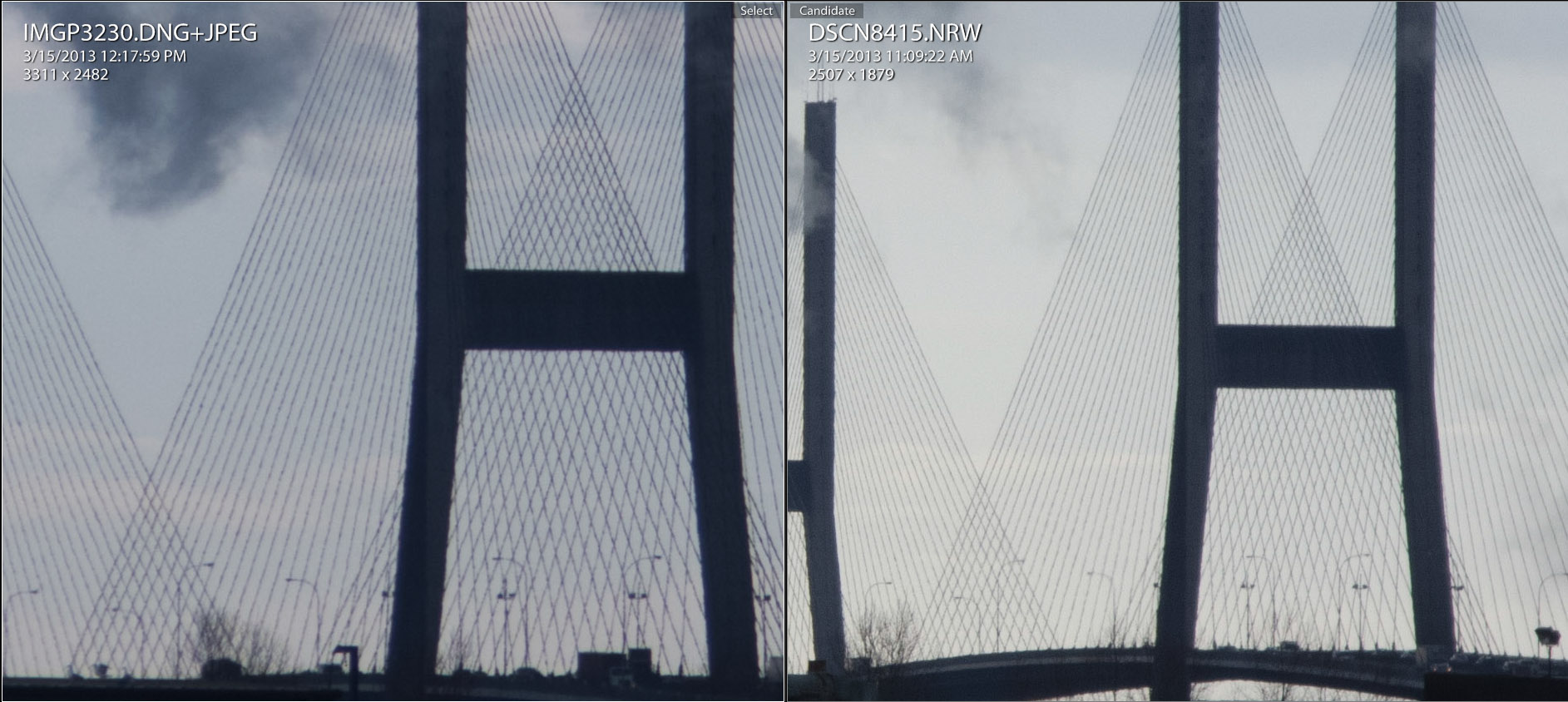
A final note here is a comparison 100% crop from the Nikon P7000 at full zoom (200mm equivalent) vs the Q homebrew (220mm equivelent). The Q is on the left.
3 comments | tags: lenses, Pentax, Q | posted in Cameras, Photography
Mar
18
2013

Forged in the fires of Mordor this camera rules them all…oops apparently this isn’t that kind of elfin camera and its plastic would melt quicker than butter on a hobbits scone. What it is though is diminutive and equipped with a nice 26mm f2.8 prime lens. This hobbit sized APS camera is small enough that you can even forget it’s in a pocket. Like most cameras of its time control only goes as far as turning the flash off and I’ve discovered it doesn’t focus well when you put it up against a chain link fence ( there are two examples of that in the pictures they should be easy to spot). It’s almost hard to say if the lens is better than the zoom of the original Elph because APS film is just awful, it is the great equalizer. The specifications for the lens though are 32.5mm focal length equivalent in terms of 35mm film and 4 elements in 4 groups one of them an aspherical element so I’m going to say its better than the film would suggest.
2 comments | tags: APS, Canon, film | posted in Cameras, Photography
Mar
14
2013
Pictures from February 2013 with my Yashica Electro GT. More information about his camera can be found on my blog here Yashica Electro GT and here Yashica Electro GT and some more pictures here Images. What can I say I like this camera and keep coming back to it.
1 comment
Mar
12
2013
5 comments | tags: iPad, Painting | posted in Painting
Mar
9
2013
In response to the uproar over Hasselblads Lunar rebranding of the Sony Nex7 I thought i would point out that this sort of thing has been going on for a long time. Many cameras have been released under different names. It’s been mentioned on the Internet how many parts the Minolta Freedom Escort and the Leica Mini share but a visual comparison is always nice. (Update the Olympus AF Mini is part of this litter)


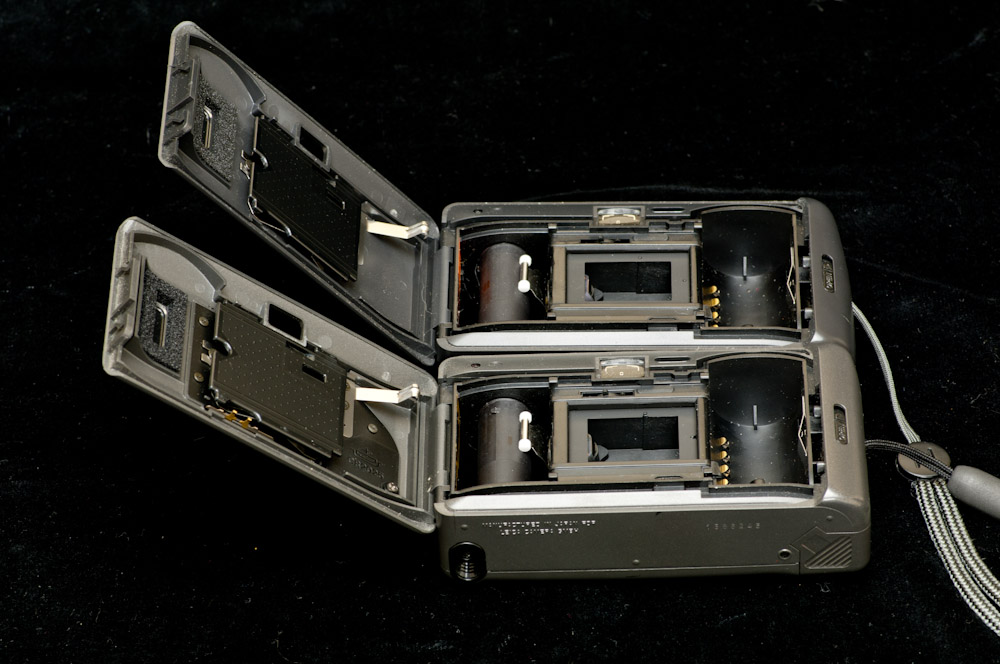
Update this post has been sitting written and ready to post for over six months it just got pushed to the back. I could have removed the no longer topical reference to the Hasselblad but that camera is still funny.

Wait it’s triplets! As Drewboom pointed out to me the Olympus Trip AF Mini was seperated from these two at birth and it definetely shares major parts with its siblings.

7 comments | tags: Leica, Minolta | posted in Cameras, Photography
Mar
7
2013

You might think with a lens branded with Schneider Kreuznach it would be a decent performer but I think Samsung used the engineering budget to try and cram as many electronic tricks as they could into it. How often have you thought, I wish my camera would take a picture and then zoom out on it’s own and take another and then another? Me either. Or to take a picture and then turn itself off and back on again from 10 to 60 seconds in ten second increments or 10 to 60 minutes in 10 min. increments ,and take another and so on until you run out of film. Hey wait a minute these are actually the kind of features I like to exploit maybe I’m being too hasty. Part of the problem with this camera and really all the longer focal length zooms from this era is that the lenses are super slow at the long end. In the Samsung’s case it’s an f stop of 12.2 so hand holding is going to be a challenge. For example using 200 ISO film on an overcast day with a light level of say 14EV (thats a typical day around here) an aperture of f12.2 would require a shutter speed somewhere around 1/60 second which isn’t really enough to hold a 140mm lens steady. Even using 400 ISO film isn’t enough. While writing this I’ve sold myself on trying it again with some better 400 film and staying closer to the 38mm end of the lens.
1 comment | posted in Cameras, Photography
Mar
5
2013
Despite the fact that I shoot lots of digital images and that sharing and posting them is even easier than doing so with film,, many of them remain on my computer unposted and unseen. It can be difficult to remember what images I have already used and there is some inevitable overlap between my film and digital pictures but here are some pictures of windows from the past few months.
They are taken with various cameras (Pentax K-7,Pentax Q,Nikon P7000)
2 comments | posted in Photography
Mar
3
2013
I believe I’ve said enough about the Olympus (1) Stylus(2) Epic(3) in the past so here come the pictures. It’s Ektar 100 if your wondering about the film.

no comments | posted in Photography
Feb
28
2013
When Pentax released the tiny mirrorless Q camera a lot of people’s immediate reaction was to dismiss it solely based on its sensor size of 1/2.3″ (6.17 x 4.55 mm), but in doing that I think they are missing the point. I don’t see the Q as a replacement for any other type of camera necessarily but something entirely unique. I find the image quality adequate for snap shots particularly with the 8.5mm prime lens and with the addition of the fisheye lens there is nothing else like it that can fit in a coat pocket. The only time I choose to take my larger Nikon P7000 is if I think I will need the longer lens but that too can be addressed with the recently announced Pentax 06 zoom with its f2.8 83mm to 249mm equivalent in terms of “full frame”. But as this is a comparison of sorts, despite the difference between the type of cameras what really matters is the image in the end. Yes the K10D is now 6 years old but it’s still a DSLR and you would expect it to decisively out perform the Q if you just look at the size of the sensors.
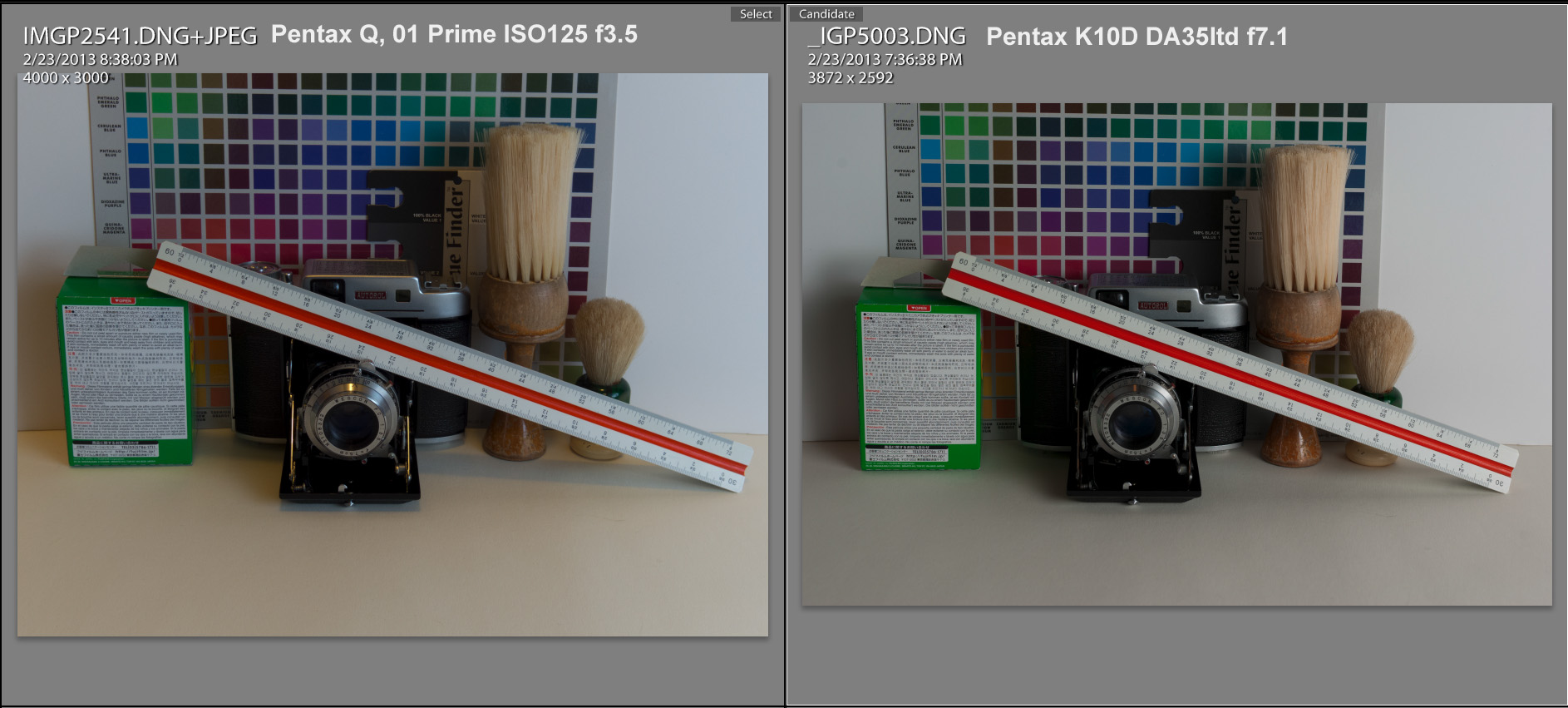
For this test I used the Pentax 01 Prime lens at an aperture of f3.5 which gave me enough depth of field for my scene yet did not result in a softening of the image due to diffraction. For the K10D I used the excellent Pentax SMC DA35 ltd. at an aperture of f7.1 which also yielded enough depth of field and good lens performance. There is a small difference in the field of view for these lenses so I did my best to match it and also the Q sits much lower on the tripod so I had to adjust for that as well. Both cameras were set to P-TTL flash exposure using two AF540fgz flashes into an umbrella. I found the Q exposure and colour to be slightly more accurate but both were shot as RAW. My purpose was not to test the two cameras necessarily at the same setting but at their individual best much as I would try to use them.
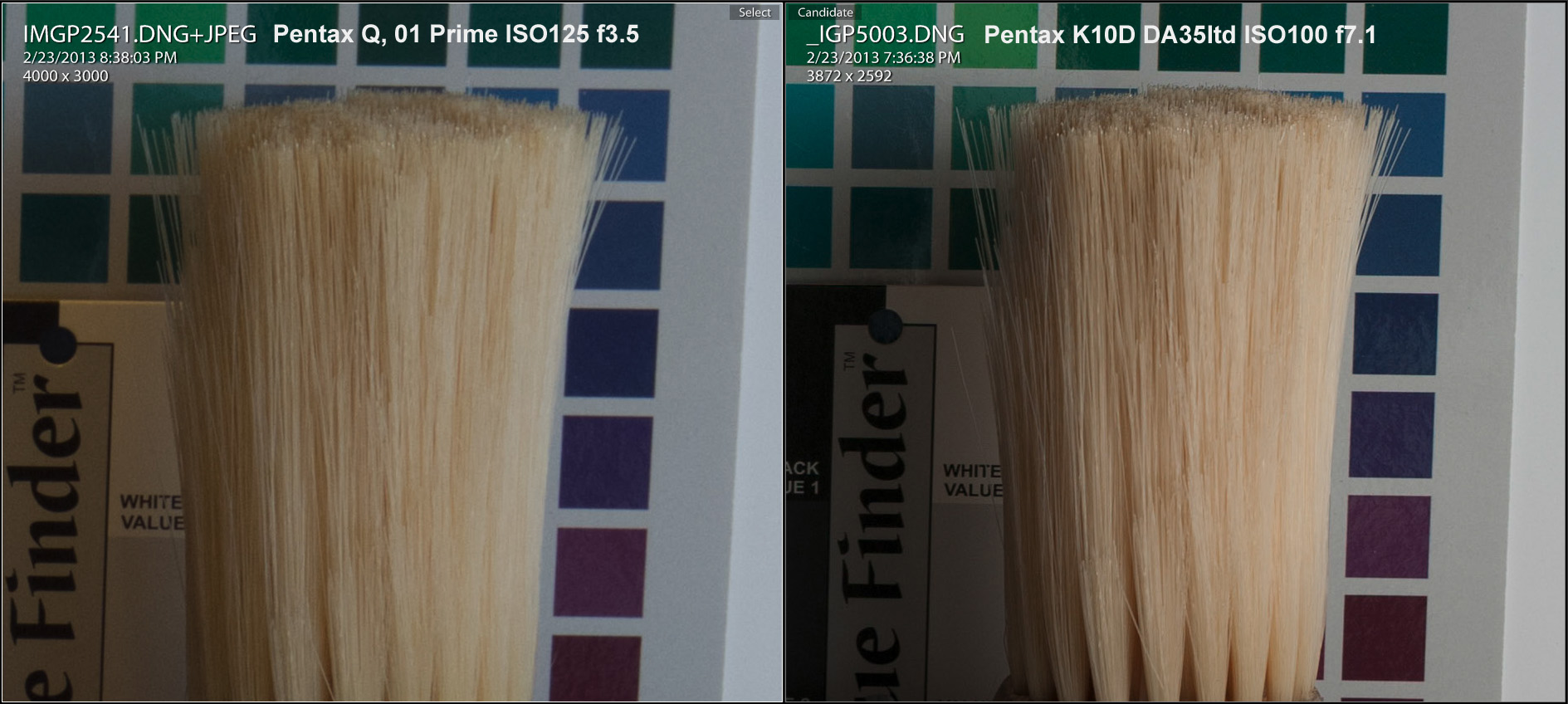
You can see in this first example that the K10D’s rendering of the bristles is much sharper and better defined. This is from an area of the image some way from the center but not really yet a corner. Chalk one up to the K10D and the DA35 ltd
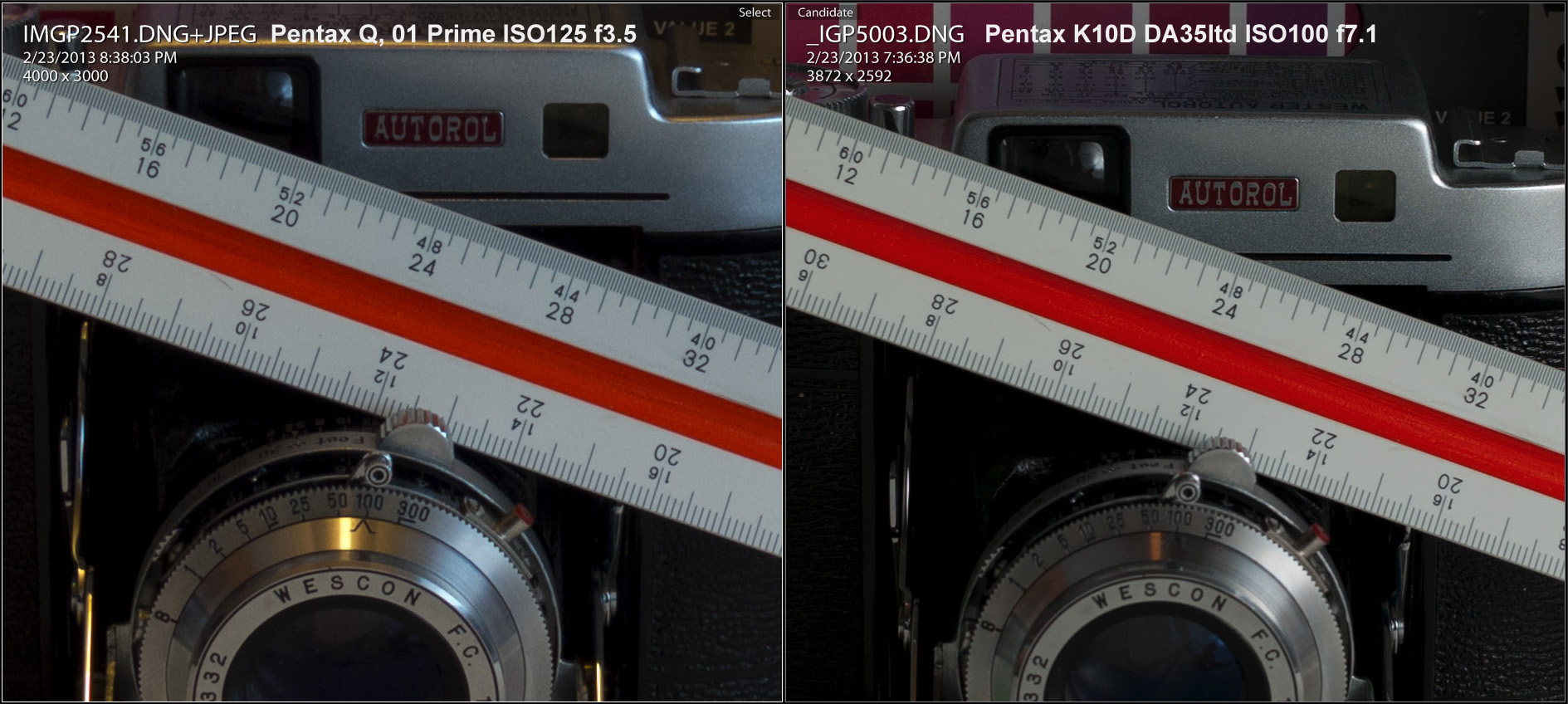
Towards the center of the image I find it to be a bit of a toss-up they both seem to have a similar level of sharpness with the slightly higher resolution of the Q perhaps allowing for more detail, I would call this a tie though when I take into account what appears to be slightly different point of sharpest focus.
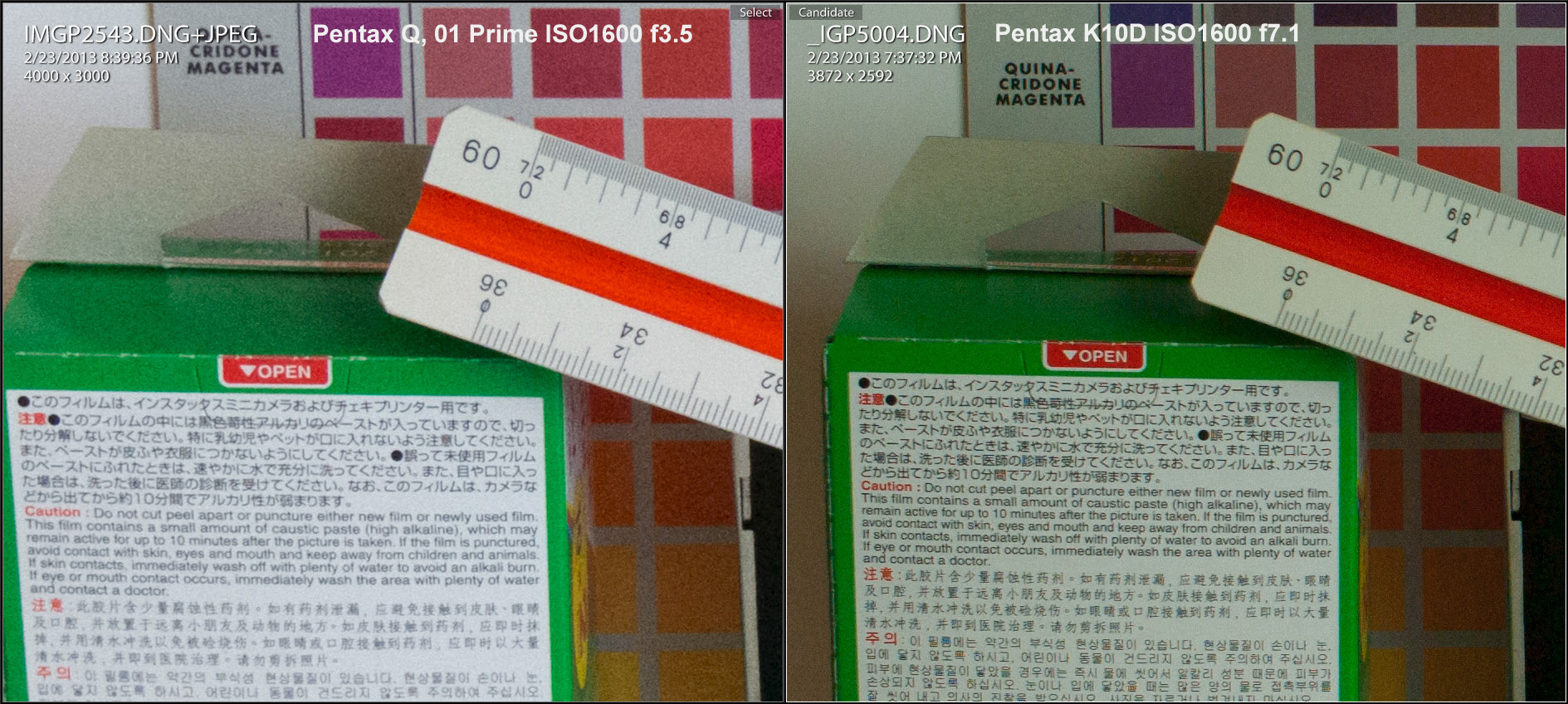
At 1600 ISO though the two cameras behave very differently there is more noise in the Pentax Q image but it also retains more detail as seen in the marks on the ruler. As a person that still shoots 1 to 2 rolls of film a week I find the Q produces noise that looks a lot more like film grain so I prefer it. What I take from this testing is that for everyday shooting the Q performs well enough that it can be my primary camera and only when I need to do something outside its capabilities is it necessary to choose something else. Of course many people are saying this of smart phones with their cameras so it stands to reason that the Q is up to that task. A small amount of online research shows just how much effort is going into engineering small sensors mostly because of smart phones so there is likely to be a quicker and more dramatic level of development in this area.
5 comments | tags: K10D, Pentax, Q | posted in Cameras, Photography
Feb
25
2013
Not a very flattering nick name for a camera I will admit but a lump is a lump. Being that the camera is now over 50 years old though it can be forgiven. The lens isn’t that fast, having a maximum aperture of 3.5 but the 4 elements in 3 group 45mm ‘Rokkor’ lens is surprisingly good (when it was in focus). My camera needs a little TLC to tighten the lens to the camera body before the two parts part, and to adjust the rangefinder. Its build is nowhere near as good as the Minolta Super A but then it’s not as heavy either.

Despite the issues I had with the rangefinder not working and the lens not being tightly attached to the body (It’s not interchangeable the lens is supposed to stay on) I was surprised by the results which again were obtained on cheap film and without a meter. Its results like this that convince me to do silly things like make cameras from Lego or random camera parts.
Oh I almost forgot this camera has the worst rewind lever ever and took me several minutes just to rewind a roll of 24. As you turn the tiny little wheel, with no mechanical advantage, it goes back almost as far as you just went forward. It was a struggle.
2 comments | posted in Cameras, Photography