Oct
9
2011
I wanted to show how little is required to do relief printing. In this photo is everything that is required; A block of material to carve, paper to print on, ink to print with, a hard surface (glass in this case) to roll out your ink on, a rubber roller and something to force contact between block and paper. I am using a bamboo barren but a wooden spoon can be used as well. And of course something to carve with. It is a very accessible art form, maybe you did it as a child cutting shapes into potatoes and using them as stamps. Art or craft it’s irrelevant if you enjoy creating something.

Here I’ve done a proof to see if there is anything that needs refining. I changed my mind mid way through creating this block, dropping the idea of a colour gradient back ground and just leaving the individual cuts visible. This clearly isn’t a lesson in how to print but I hope that seeing the simplicity of relief printing is encouragement if it’s something you’ve thought of doing.
2 comments | tags: crow, prints, relief | posted in Art observations
Oct
7
2011

Here is a way to set a custom macro mode for the Nikon P7000 and save it to one of the user presets. But Wallace you say “There’s already a dedicated macro mode!” To (Insert your name here) I say “Not good enough”. The problem is that the camera does a couple of things you have no control over when you set it to the macro scene mode. One is that it zooms to the widest setting (28mm equivalent) not a focal length one thinks of right away for macro, considering it results in nearly poking the subject with the lens. The other thing that happens is that the camera switches to jpeg shooting even if you were previously shooting RAW. For these reasons I’ve created my own and stored it under U1 on the mode dial.
This is how I went about it. The first step after turning on the camera and selecting a user mode is to set an ISO or ISO range as this will be stored in memory. This is followed by pressing the menu button, If U1 isn’t yet highlighted use the command dial to navigate so U1 is selected and shows the User setting parameters as in the image bellow.

I’ve set my camera up for Program mode but aperture priority would also be a good choice. Ive also selected an equivalent focal length setting of of 85mm as this provides a good working distance. Under Photo info I’ve chosen to display the histogram and a grid to aid in judging exposure and composition.

I’ve also chosen to have the flash off by default as I rarely use the built in flash for macro shots, it’s just to close to the lens and too harsh even when it’s output is dialed down. The next critical setting is of course focus which needs to be set to Macro close-up. The remaining settings are AF to Center normal and AF assist to OFF.
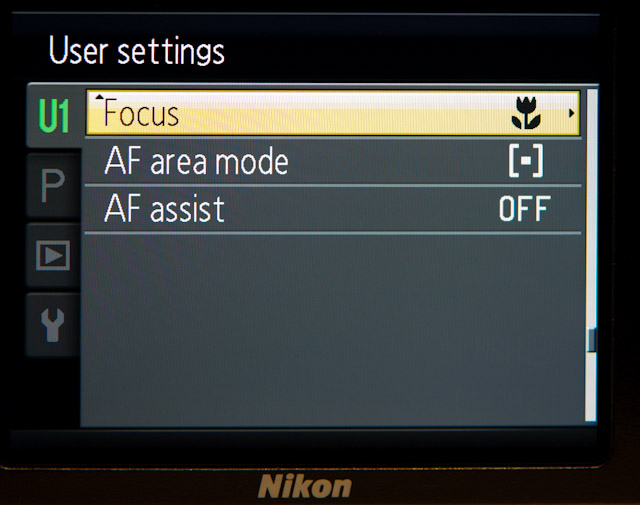
When you have made all the selections you must save them. During the save confirmation you can view all of the current camera settings by turning the zoom dial towards telephoto. This screen (not shown) summarizes all of the settings
Now anytime you turn the mode dial to U1 the camera will switch to your chosen ISO , set focus to macro with a center focus point and zoom the lens out to 85mm (35mm equivalent) with all the rest of your setting as well. You can modify these settings anytime but you must re-save them if you want them to be the default.
If you want to take extreme close-ups you need to zoom the lens to the widest setting, just be careful not to poke your subject with the lens, flower pollen is particularly hard to clean off.
no comments | tags: Nikon, p7000 | posted in Cameras, Photography
Oct
5
2011
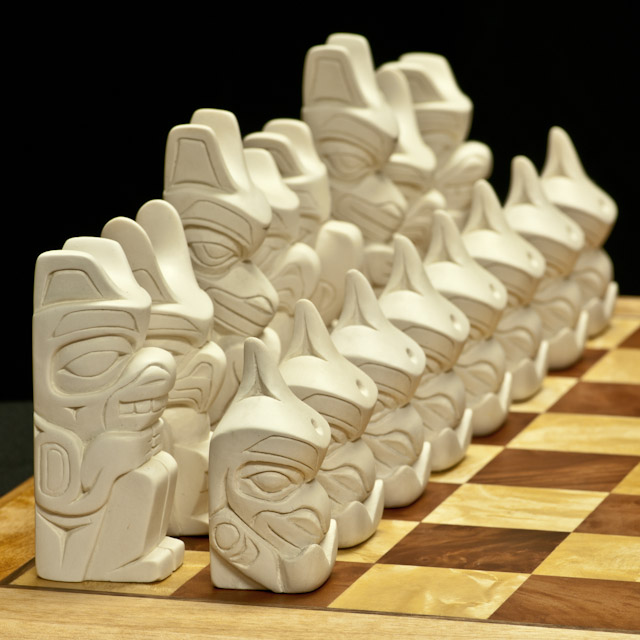
I recently took some photographs for two artists who produce some incredable pieces. The chess boards were made by Marcel Daigneault while the Haida mythological themed chess pieces were cast from carvings by Derek C. Heaton.
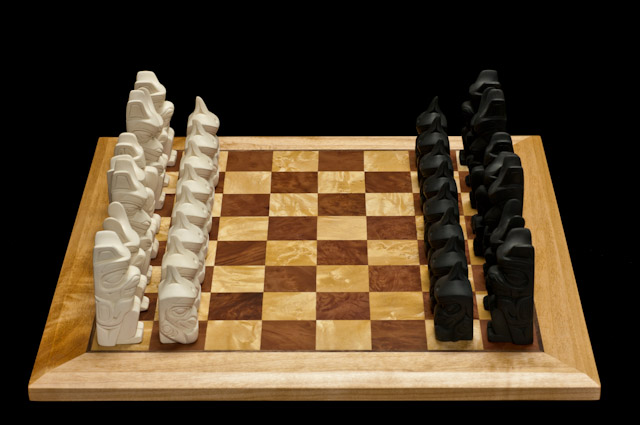
Marcel tells me the boards are made from Arbutus and Aspen and polished with beeswax. I am in awe of not only the skill he applies to his craft but the artistry too. I also took pictures of a cedar chest that Marcel made and you can see from the design of the top how organic and lyrical much of his work is.


Both artists work is curently available at the Tribal Spirit Gallery in Langley B.C.
no comments | tags: carving, chess, Haida, Wood | posted in Art observations, Photography
Oct
3
2011
If you’ve been waiting to find out which point and shoot camera you should have bought ten years ago, your prolonged wait is over. PreviouslyI posted about the Canon Sure Shot Classic and the Pentax 24EW and now that I have the film back and scanned I was able to make a results comparison. Well the Pentax wins hands down from 24 to 38mm but considering the Canon starts at 38mm that isn’t praise. In almost ever picture under the same conditions the Canon produced a better result, both through exposure and image quality. As I used the same sensor (Kodak 400) it really did come down to the cameras. Here are some of the shots in a side by side. If it’s wide you want though the Pentax is the one.

Above you can see the Pentax can get a little closer for a zoomed macro and bellow the difference between 24 and 38mm is pretty clear.

This crop shows both cameras at there maximum zoom 120mm (Canon) vs 105mm (Pentax)

This detail crop really shows the difference. In all these pictures I’ve made no effort to deal with the grain of the film or optimize the images beyond trying to scan them accurately.
This just in Olympus has joined the conflict with the mju III 150 (circa 2003) with it’s 8 element ED 37.5mm to 150mm lens, stunning the competition, and again causing the Pentax to faint.

4 comments | tags: Cameras, Canon, film, Pentax | posted in Cameras, Photography
Oct
1
2011
Today I was initiated into the secret world of photo walks. OK it wasn’t secret at all in fact there was only a short initiation followed by a hazing that consisted of being mocked for my choice of cameras. It was the Scott Kelby Fourth Annual World Wide Photo Walk otherwise know as the S.K.F.A.W.W.P.W. It was nice to meet other photographers and strange to be in the presence of so many other photographers taking pictures. If you’ve ever worked on a construction site, different trades continuously walk past each other without a work spoken. I mean if you have to walk passed someone 40 times a day are you really going to say hello or even excuse me every time? Well it was a little like that but a bit more polite without anyone stealing your extension cord. Everyone tried to avoid walking into each others pictures and it was quite fun. It’s certainly something I will do again and I look forward to seeing the other peoples images, I think there will be as much variety in the shots as there was in the people.

This is the sort of sacrifice it takes to get that one shot.
2 comments | tags: Photography, walk | posted in Photography
Sep
29
2011
I took some shots of a chest and chess boards made by wood worker Marcel Daigneault. He also brought a set of incredible native themed chess pieces made by another artist. The Polaroid really doesn’t do them justice but it’s time for a Polaroid so what can you do?

no comments | tags: polaroid | posted in Photography, Processing
Sep
28
2011
These are all shot with the HTC Evo 3D phone, in 2 dimesions however.
no comments | tags: cell phone, HTC, shelves | posted in Cameras, Photography
Sep
27
2011
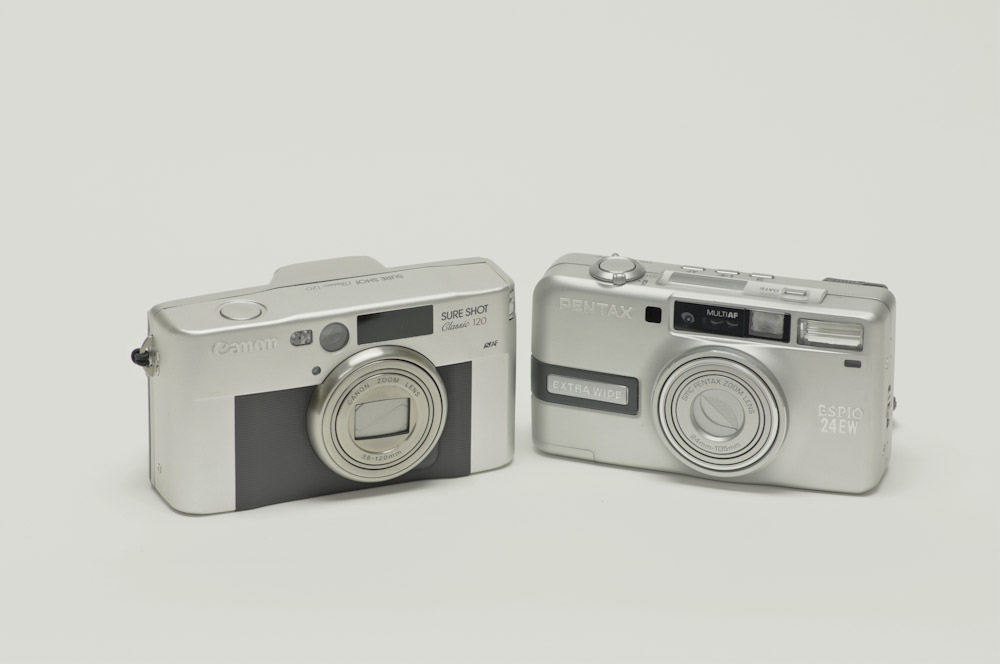
What we have here are two very good compact film cameras from that awkward time when the digital megapixel race was to get to 1.2 Million. Digital wasn’t quite there or in the mainstream and people were still wanting to take pictures of their cats. So If you wanted a good quality camera around the turn of last century (I always wanted to say that) these were two top choices.
They are well built cameras with very good optics. The Pentax 24EW has a 24mm to 105mm zoom which is very wide considering most others point and shoots of the time started around 35mm. The Canon on the other hand has a 38mm to 120mm zoom which gives a bit more reach while giving up the wide end.
One interesting feature that both cameras posses is the ability to automatically zoom to frame a portrait. If you select this mode on either camera and then give the shutter a half press they will change the zoom setting to take a head and shoulder shot of your subject. That may not be amazing for a digital camera but don’t forget these are film point and shoots, from the turn of the last century.
The Canon is considerably heavier than the Pentax which may be a detriment in some cases but allows it to remain standing even when fully zoomed.

You can also see in this picture that the Canon flash has popped out of it’s side bay door. It does that when ever the camera is turned on whether needed or not. Pentax you are now forgiven for drooping.
I recently shot a roll of Kodak 400 through each of them and should get the negatives back this week, at which time I will post the comparison results. See isn’t film fun, the suspense is harming me severely.
1 comment | tags: Cameras, Canon, Pentax | posted in Cameras, Photography, Uncategorized
Sep
26
2011
This is a test of the WordPress for Android app. The main problem I see with this is I can’t type fast enough. I’m actually a pretty good typist on a regular keyboard, and can put my thoughts down as they come to me. For short posts though this may be fine. Phew I have to stop soon, right after I add a photo.
no comments | tags: android, cell phone | posted in Art observations


