Oct
3
2012
When taking pictures you should always keep your mind open to new ideas and possibilities. When I saw just how much contrast there was here (A dark hallway with a bright south facing windowed doorway), I knew there was no way to balance the light but that I also wanted to create an image. My response was to go for a silhouette, taking it further I switched to manual focus defocusing completely, giving soft Indistinct edges. Finally I did a bit of editing in Snapseed to add the blue cast and textures.

The point is that no matter the circumstance if your intent on creating images when presented with what appear to be problems, it’s actually an opportunity to try something different without expectations.
1 comment | posted in Photography
Oct
1
2012
I have a mix of outdated APS film that must have been stored in the desert, the results are horrendous producing “thin” (see note) negatives that have horrible colour casts mostly a sickly green with red shadows. Oh well isn’t that what Instagram does? I’m embracing this and just shooting it anyway.
Speaking of Instagram this little roll of APS has an interesting social media life. The local camera shop where I have my film developed had an issue with their film developer so they sent this roll out to be processed at another store where they have custom work done. Now we’ll say the film was lost track of, not actually lost just a lack of certainly of where it was. It’s at this point that the person doing the developing takes an Instagram shot of the APS roll to show the old school 1990’s. If your still following me, the person at the first store sees this and asks if the name on the package is for Koopmans (that’s me) and it turns out it is. Film found, the moral of the story is that Instagram is good and APS is old school.
These images were shot with the Pentax Efina T which I will give another try because it really isn’t the cameras fault I loaded it with crappy film.
* A thin negative in this case is one with low amounts of silver halide forming the image resulting in a negative that has low density and contrast, not a lot of information captured. There really is no digital analogue but if you can imagine the histogram it would be a very narrow spike. (yes I just did that, using the noun analogue in reference to the adjective digital)
2 comments | tags: APS, film, Pentax | posted in Cameras, Photography, Processing
Sep
29
2012

With this sketch it’s apparent how I have used a photograph as the source. While every stroke is unique and not directly derived from the photograph I had the source image as an underlying layer while painting. This image could have been improved if I had painted some more dark greens at the base of the half barrel. As it is the barrel is not grounded and appears to float on the image plane losing the three dimensional effect, appearing flat and giving away it’s photographic origins.
Not only can you use the iPad to sketch but you can use it to capture your source material too with it’s built in camera or through the camera connection kit. All of this was done far away from any Internet connection or source of AC power. I charged the iPad off of a 12V inverter whenever I needed to.
no comments | tags: iPad, Painting | posted in Drawings, Painting
Sep
27
2012
It’s pretty much universally accepted that digital photography today provides a better outcome than film as well as a better user experience. Now with more than a decade of digital being mainstream I’m having a look back to see just when that barrier was crossed for the average user. For this comparison (there may be more) I selected two cameras that were available in 2001. The Olympus D-370 is a 1.3Mpixel (1280×960) camera with a 4.5mm F4 lens with 5 elements that gives a 35mm equivalent field of view. And weighing in for film is the Minolta Freedom Escort with it’s 34mm F3.5 four element lens and it’s filmyness. To be fair the Minolta is about ten years older than the Olympus but the film is new.
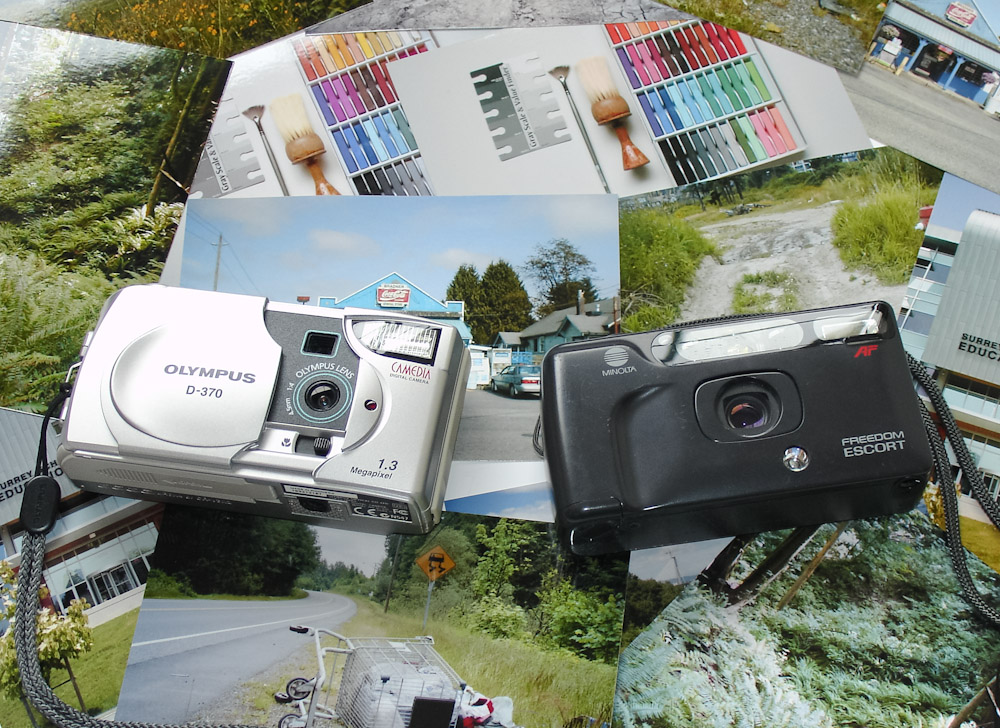
Seeing as most people get prints that are 4×6 I thought I would see if at this size snapshots from the two cameras would be comparable. At that size the (1280×960) of the Olympus should give nearly 220 pixels per inch. I scanned the negatives at higher resolutions but downsized to a comparable 240 PPI for printing. Both cameras actually produced decent 4×6 prints but the film camera took the edge with it’s better lens and films superior dynamic range.
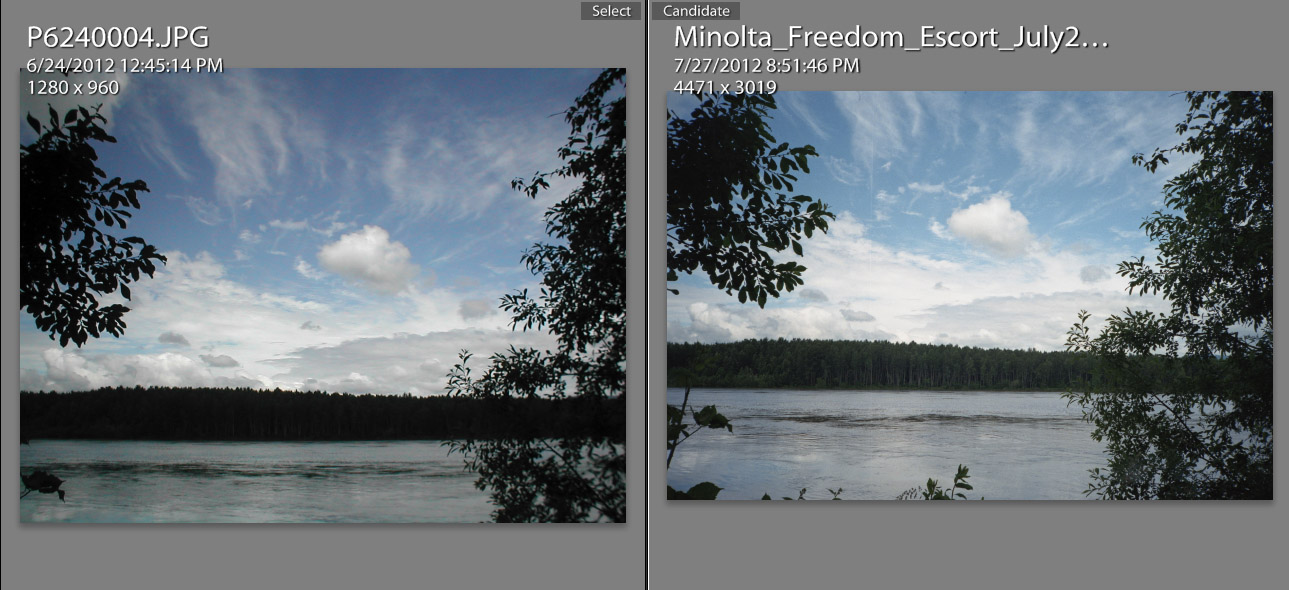
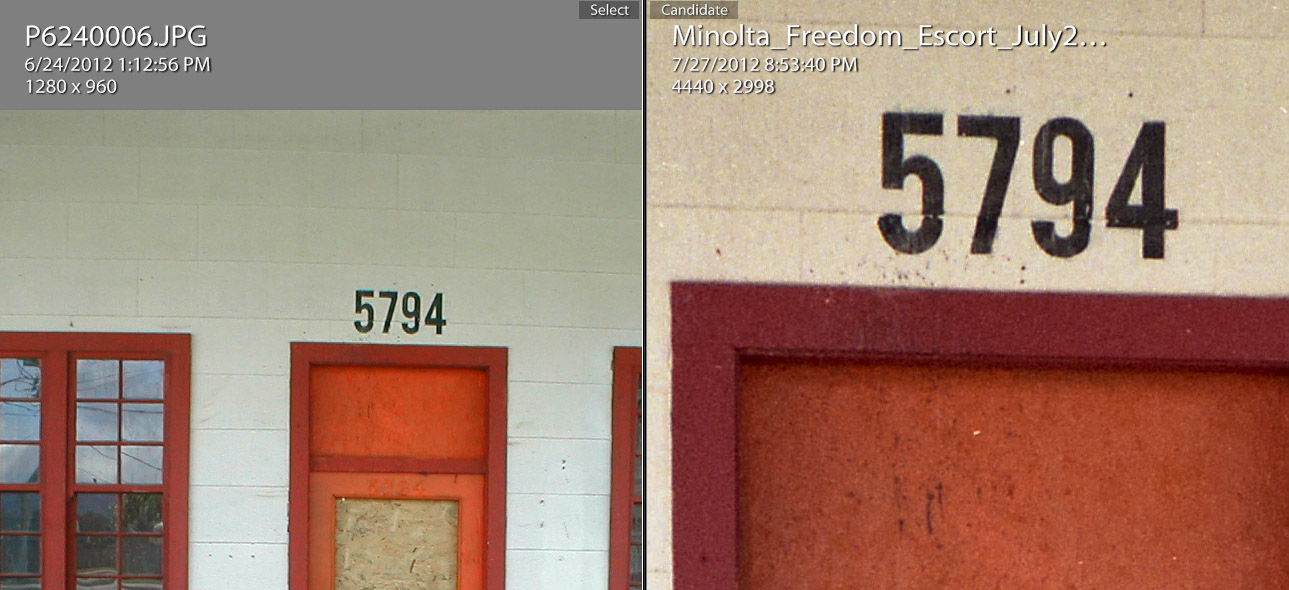
The Olympus prints were only sharp in the center and the sensor couldn’t record much detail in the dark areas of high contrast images. The Minolta with Fuji Superia film was able to record much of the range of any of the scenes and a lot more detail.
So what exactly does this prove? Well for one thing the output quality of pretty much every camera for the last 10 years has been adequate for making 4×6 prints and web sized images. It wasn’t all flowers and butterflies though if anyone cares to remember the difficulties with getting your images off of a camera and into the computer around that time. The other thing it proves is that this was not the time where digital exceded film for the average user not using an SLR or DSLR.
Here are two comparisons the last one zoomed in to one to one, leaving no doubt about films 2001 superiority.
From here I will pick a different camera combination with higher megapixels and see if I can find that cross over point.
5 comments | tags: camera, Digital, film | posted in Cameras, Photography, Processing
Sep
24
2012
One more post of images from The Museum of Anthropology as well as a few other images from that roll. These were shot with my Baby Bessa which is one of my favorite camera’s Voigtlander Baby Bessa Voigtlander Baby Bessa Sample images Voigtlander Baby Bessa June 2011 Baby Bessa
no comments | posted in Photography
Sep
21
2012
Don’t you just love to hate oxymorons?
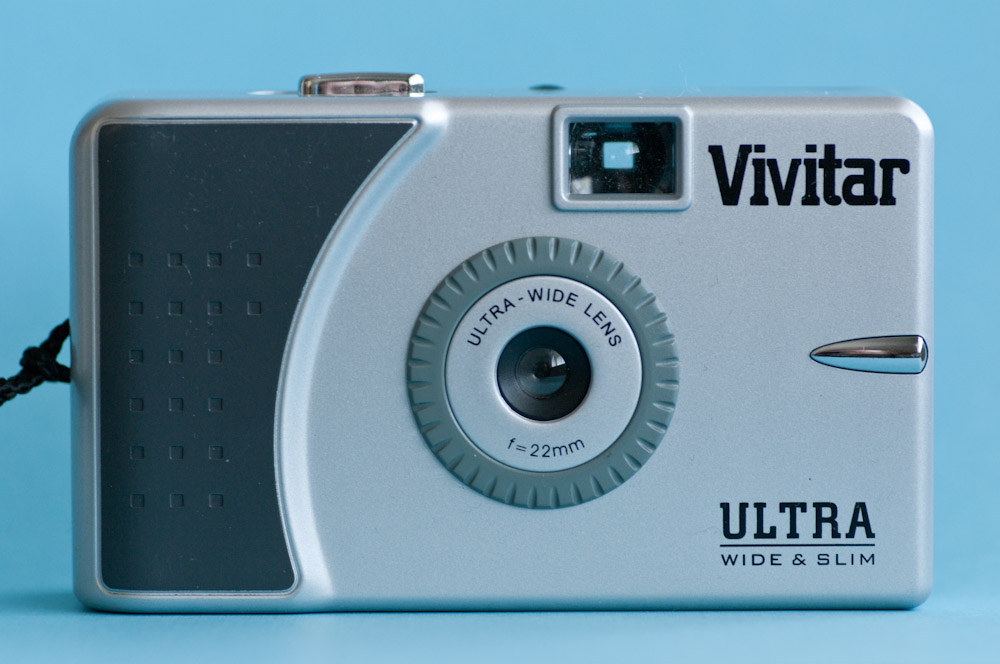
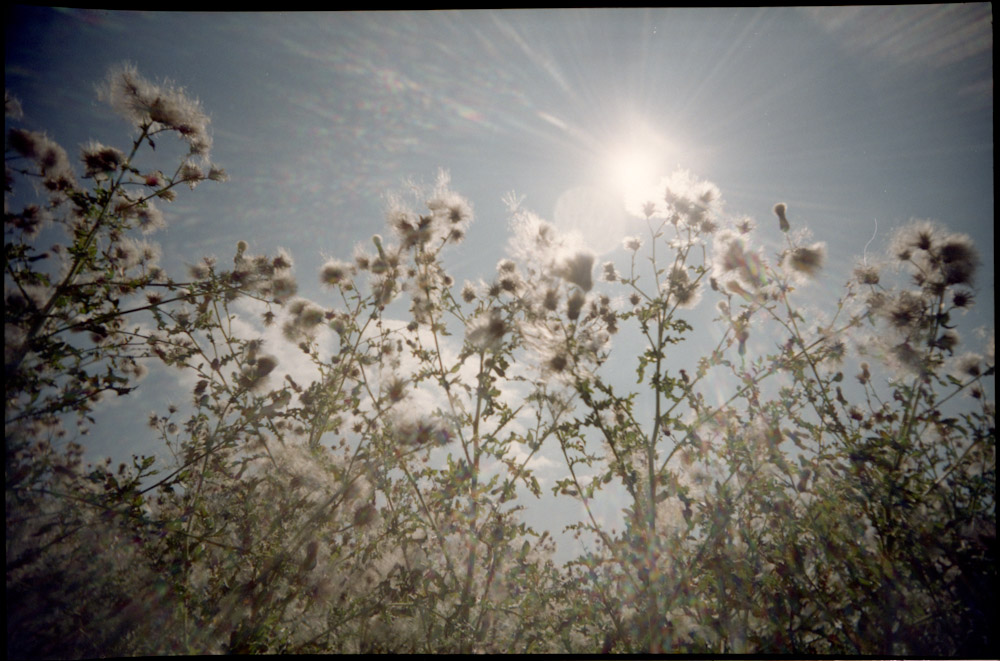
The Vivitar Ultra Wide and Slim is one of the ultimate plastic cameras. It has a “Ultra wide” 22mm lens and is an incredibly small camera, you could ever say it’s massively slender. One thing to keep in mind is that it has a fixed aperture of F11 and a fixed shutter speed of 1/125sec. So to get the best results you want to shoot in circumstances that require exposures around that level. I was using ISO 400 film so that would be about EV12 or average daylight. Looking at the roll of film as a whole it’s clear that I pointed the camera towards the light a lot. Well it’s a plastic lens of course it’s going to flare so let it flare. And vignette don’t get my started with the vignetting it’s perfectly awful! OK so it’s bad in a good way and I’m nearly out of oxymorons.
1 comment | tags: camera, film, Photography, wide | posted in Cameras, Photography
Sep
19
2012
Actually it’s more like a black hole sun on my Fuji instant print. I’ve never seen this before but I believe it’s solarization. A quick look through my 1978 edition of The Manual of Photography explains that at a certain point of the exposure curve of a negative the density actually starts to decrease. It also suggests that the exposure required is “commonly on the order of magnitude of one-thousand times greater than normal” . That sounds like the sun to me.
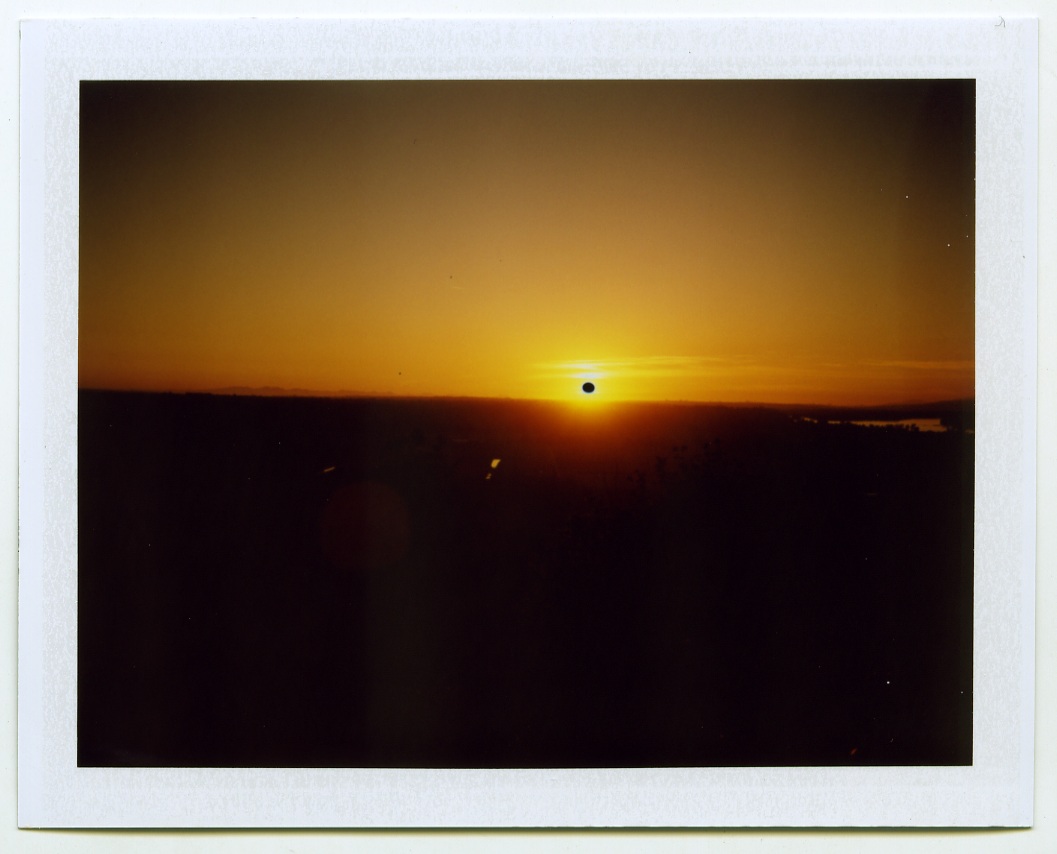
In addition to pointing the camera straight at the sun I also used a Cokin 85C filter to make sure the image was nice and warm. I’ve found that FP100c produces prints on the cool side of the spectrum especially when compared to the Polaroid Spectra I’ve also been shooting.
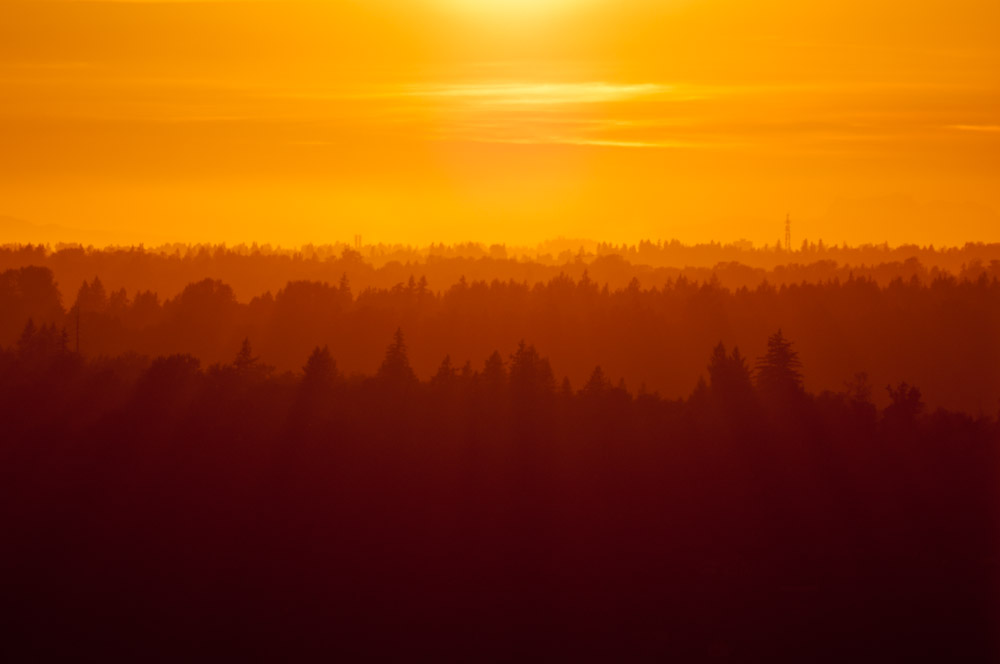
Here is a digital shot I took just a little earlier.
no comments | tags: film, Fuji, instant | posted in Photography, Processing
Sep
16
2012
Most images you ever see of Bill Reids Raven and the First Men is from the front so I thought I would show that it is really a 360 degree sculpture where every angle is as good as the last.
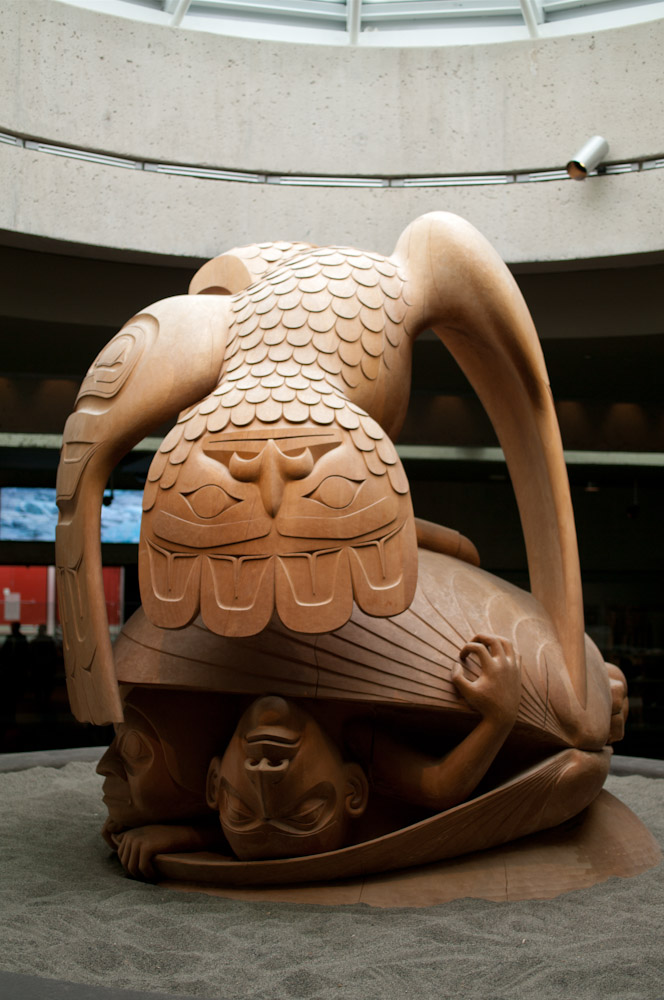
These are images I took while visiting MOA. I have to say it was an incredible experience and I only left when they were closing for the day. There are an impressive number of artifacts from the many first nations of the West coast. Something that I found unique in my experience was the ability to open the hundreds of drawers beneath each display case that contained even more items. This small group of photo’s can not convey the grandeur of the large totems in the “Great Hall” or the beauty or the thousands of items. There are also many other cultural artifacts but the primary focus is on the first nations people of the coast.
Here is a link to the PDF book describing the making of Raven and the First Men
no comments | posted in Art observations, Photography
Sep
14
2012
no comments | tags: iPad, Painting | posted in Painting
Sep
12
2012
I was flipping through an old notebook from when I was in art school and found this polaroid of a “master copy” I had attempted (Please do not look up the original for both our sakes) What can I say you start somewhere and hopefully get better or switch to photography if you don’t. It is my intention to put down the cameras a little more often and do some more painting. Running across an image like this is a nice reminder, much nicer than being poked with the sharp end of a paintbrush.

no comments | tags: Painting | posted in Painting