Apr
12
2010
Unfortunately I was unable to attend the Bradner flower show this year, but I did start this painting yesterday from reference photos I took previously. While a large field of daffodils is attractive, I think that when there are different varieties being cultivated it is all the more beautiful.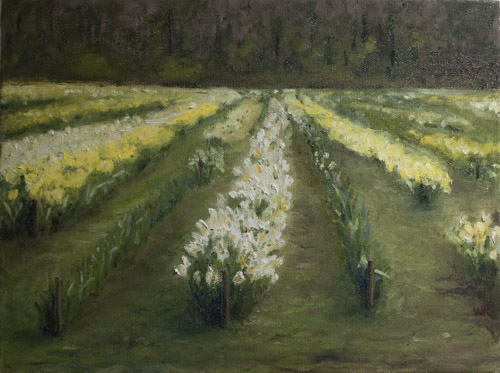
2 comments | tags: flowers, oil, Painting | posted in Painting
Apr
10
2010

As a break from what I have been primarily working on and as an excercise I painted this today.
no comments | tags: flowers, oil, Painting | posted in Painting
Apr
9
2010
“I’m so young and you’re so old”-Paul Anka
No not that Diana, the made in Hong Kong plastic nearly everything camera of the early 1960’s. I spotted this camera in an antique store. It was absolutely the worst camera I have ever seen, so I bought it. It really can be distilled down to this, it is a semi light tight box with a single element plastic lens that produces an assortment of distortion and yields images with less contrast than Banff in a blizzard. So what is the appeal? Some people claim it allows the freedom to just create images. I claim it allows you to blame the camera when you don’t. Yes a distinctive look can be achieved with this camera but at what cost. For me I believe using it was a one time deal. I would rather use a Zeiss Ikon or a Voigtlander Bessa, if I want to shoot 120 on an old camera, I at least might have a chance of predicting the results and I’m sure I’ll still retain artistic freedom.

2 comments | tags: camera, Diana, film, Photography | posted in Cameras, Photography
Apr
4
2010
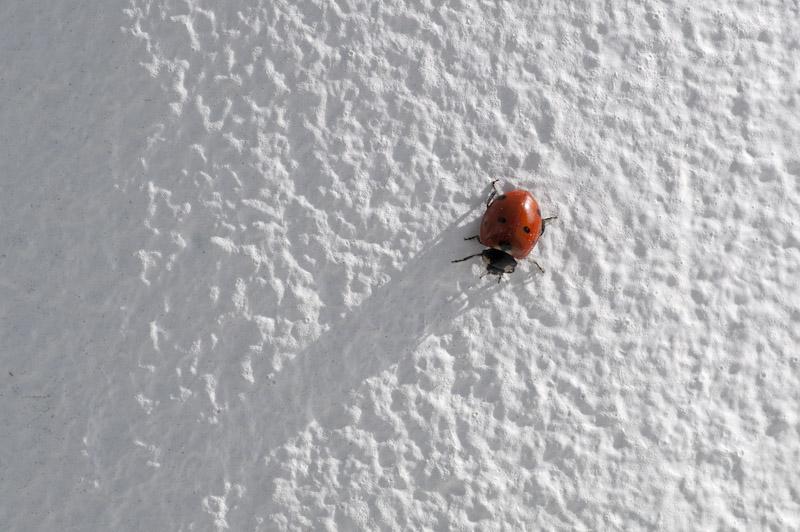
As I was sorting through some resent shots, I started to think about what made one similar shot better than another. Both images present the viewer with a single point of interest on a blank background, in fact they are the same subject. So what are the defining differences? If we ignore for the moment the difference of shading of the background, I accredit the main difference to be the size of the subject relative to the ground. The first image gives a greater sense of scale while the second is a more direct representation, here is a lady bird beetle no more no less.

1 comment | tags: composition, Photography | posted in Composition, Photography
Apr
2
2010


Here is an example of another one of the processing tools built into the Pentax K-7. You can select a particular color to remain while all the other hues are desaturated to shades of grey.
no comments | tags: Pentax, Photography, Processing | posted in Photography
Mar
31
2010

The automatic part of this camera no longer works so I thought I would find out why. It turns out that the selenium cell that is around the lens is no longer generating any voltage. It’s a very simple system where the voltage from the selenium cell deflects a needle connected to a small coil “galvanometer”. As the shutter is pressed there are two plates that move upward, on the top of these plates are steps that determine how far the plates slide based on where they intersect the needles horizo
Comments Off on Rondo Colormatic | tags: camera, film, Photography | posted in Cameras, Photography
Mar
29
2010
 Just another odd find. I’m not sure what this means and to whom.
no comments | tags: composition, film, Photography | posted in Photography
Mar
27
2010
 In this image I have used several visual tools to draw the viewers attention to one specific area of the frame. To begin with the manner that the lines of the wire converge at the point of interest leads the eye inward. This is reinforced by the contrast of focus at the center verses at the edges. This differential in sharpness was achieved by selecting a large aperture which provides a shallow depth of field. This visual cue mimics one way in which we perceive depth in the real world. The last thing I have done was during processing I increased the brightness contrast between the center of the image and the area surrounding it. Whether this is a good image or not isn’t crucial, but it does achieve the intended outcome.
1 comment | tags: attention, BW, composition, eye, focus, lines, viewer, wire | posted in Photography